


Global Strategy Report, 28/2022
Abstract: Many national and international efforts have focused on countering violent extremism by military means. The current responses to religious radicalization have been mostly kinetic and they have been less effective than had been hoped, due to a variety of aspects including their often-negative reception by the local populations as well as a lack of adequate synergy between the organizations involved. Combating radicalization in the Sahel is not just a question of fighting extremist groups but also reducing perceived marginalization as well as increasing economic opportunity in rural areas. Unless the drivers of violence are addressed, radicalization is expected to grow, often incorrectly attributed only to religion.
Para citar como referencia: Antúnez, Juan Carlos (2022), «The Root Causes of Violence in the Sahel», Global Strategy Report, 28/2022.
Introduction
The Operational Environment (OE) is “a set of conditions, circumstances and influences that affects the use of capabilities and effects the decisions of the military commander” (U.S., 2009). It has evolved to become an extraordinarily complex, dynamic, and adaptive system in which new actors, both state and non-state, interact (SHAPE and HQ SACT, 2008, and Bados, 2010). In today’s armed conflicts, economic, political, and social factors have become as important as purely military capabilities. Furthermore, threats to international security and stability today are more likely caused by negative and destabilizing consequences of multidimensional phenomena (involving political, military, economic, environmental, and social factors) than of a conventional armed conflict (OSCE, 2003).
The Sahel region1, where local armed groups have embraced radical religious interpretations and formed alliances with terrorist groups born in the Middle East, is good proof of the need of multidimensional analysis and understanding. This region is a highly complex environment where a large variety of terrorist and violent extremist organizations continues to challenge the state authorities and international organizations for supremacy. In the Sahel, however, terrorist violence cannot be attributed solely to the presence of radical religious interpretations. Other factors have contributed to the emergence of violence and led to the region becoming one of the most volatile areas in the world.
From a multidimensional perspective is possible to say that in the Sahel the security context is deteriorating, climate change is accelerating, the territorial footprint of states is small and demographic pressure is increasing (Defis Humanitaires, 2019). Decades of exposure to these mutually reinforcing conditions have undermined the legitimacy of central governments and rendered the region’s states vulnerable to the spread of radical religious interpretations, regime instability and terrorism (Cincotta and Smith, 2021).
In this complex scenario is essential to analyse the human environment to identify the main actors and understand their motivations and interrelationships is vital when planning and executing any military operation (Antunez, 2021). The understanding of perceptions, emotions, beliefs, and the willingness of those involved in any conflict are essential to interpret complexity and interconnection (Terrazas, 2022).
Unfortunately, this fact has not been sufficiently understood either by the authorities or by international organizations. In the Sahel, as in other regions of the world, the traditional anti-terrorist approach (based mainly on police and military actions) has proven insufficient to stabilize and ensure security. This situation cannot be achieved without identifying the main actors in the region, understanding their motivations and relationships and interactions, and influencing their will and decisions. This is the only way to identify and understand the true and root reasons for the violence in the Sahel, making it possible to counteract deep community grievances and increase and strengthen the presence and power of the state (Stanicak and Rasmussen, 2021).
The Allied Command Operations (ACO) Comprehensive Operations Planning Directive (COPD) states that it is critical to understand the effects created by the action of each actor of the OE (as well as their capabilities and attributes) when discerning the best way to exercise influence over them. (SHAPE, 2013). This analysis of the actors is carried out during the Comprehensive Preparation of the Operational Environment (CPOE), in which the Political, Military, Economic, Social, Infrastructure and Informational (PMESII) dimensions are analysed2, providing a holistic vision of the operational environment (SHAPE, 2013)3. A system-of-systems perspective offers a picture of the most significant relationships and interdependencies among the main the elements of the relevant systems and subsystems.
This paper tries to analyze all these human aspects as the only way to identify the true origins of the violence in the Sahel, using PMESII framework and including a gender perspective.
Understanding the Sahel. The Human Terrain: A multidimensional approach.
The Sahel is a vast expanse of dangerous and ungoverned spaces and frequently rocked by political violence and natural and humanitarian disasters, often related to its difficult terrain and extreme weather conditions. This situation has become even more complicated with the explosion of violence by religiously inspired terrorist groups, which have found a perfect environment in the area to carry out their activities (Sulemana, 2015). The G-5 Sahel states (Burkina Faso, Chad, Mali, Mauritania, and Niger), as well as their neighbours to the south, Nigeria and Cameroon, face terrorism as one of the greatest challenges to their stability, both nationally and regionally (Echeverria, 2017).
In recent years, the Sahel has experienced an unprecedented increase in terrorist violence. Exploiting the instability, the rivalries between the different groups, the poor governance, the large extensions of land without the control of the authorities and the porous borders, international terrorist groups, such as Al-Qaeda and, more recently, the so-called Islamic State, have increased their influence in the region, through their respective affiliated groups (Demuynck and Coleman, 2020). The security situation in the Sahel is also affected by the instability in its immediate surroundings, whether in the north due to the influence of instability in Libya, or in the south due to the violence perpetrated by Boko Haram in Nigeria (Fuente Cobo, 2016). According to a NATO South Hub document, the Sahel has joined the Levant as one of the epicenters of international terrorism. Various internal factors, combined and accelerated by the impact of “The Arab Spring” (and especially the fall of Colonel Gaddafi’s germ in Libya) have pushed the region into a whirlwind of violence (NATO South Hub, August 2021). This has been motivated by various historical and contemporary, local, and international, geographic, political and socioeconomic factors (Sulemana, 2015) that will be analyzed below.
The European Parliamentary Research Service (EPRS) assures that the deterioration of security in the Sahel is the result of the interaction of a series of factors, such as: poverty; corruption; various local grievances; separatist ideas and movements; previous intercommunal violence between herders and farmers (confronted by the rights on land and access to water and whose situation has been further aggravated by the consequences of climate change); the weak presence of the state; and the lack of opportunities for young people (Stanicak and Rasmussen, 2021).

A November 2020 NATO Strategic Direction South Hub project also identified the main drivers that lead to radicalization in the Sahel: Ethnic Conflicts, (Perceived) Ethnic Marginalization, (Perceived) Economic Marginalization, Pastoral Insecurity, Radical Preaching and Radicalization in Prisons (NATO Strategic Direction South Hub, November 2020). Understanding these elements will help predict ongoing patterns of radicalization in the Sahel.
It is also important to highlight that gender indicators for the region remain very low, revealing the presence of deep inequalities between men and women (Alliance Sahel, 2021). Women and girls are disadvantaged in many areas and do not enjoy the same opportunities as their male counterparts. This is true for almost all public sectors, ranging from unequal access to basic social services, unequal property rights and persistent gender gaps in the labor market and in the public sphere (OECD).
A deeper PMESII analysis from a multidimensional perspective of all these factors and drivers will offer a complete picture of the most significant relationships and interdependencies among the main the elements of the relevant systems.
Political
In the political domain, the security situation is characterized by a series of factors such as political instability, which influences from one country to its surrounding neighbors, disputes in certain areas between different population groups, and, finally, the interaction between different actors, local and international, state or non-state, with different agendas and interests. This instability is largely due to the lack of political maturity of the countries in the region, most of which did not achieve independence until the 1960s. This factor causes the weakness of political institutions and the instability of their government systems, as they have not had enough time to consolidate and strengthen themselves and to be recognized and accepted by society (Samake 2016).
This political immaturity is aggravated by the lack of democratic education among a population that has not been able, or has not been allowed or facilitated, to assimilate a culture of political participation and that is torn between the traditional systems of government and the new rules and democratic institutions. In this context, governments tend to ensure their legitimacy and permanence through personal networks, based on family, clan, tribe, ethnic group or social class, increasing favoritism, inequality and resentment between different social strata. In addition, they focus their efforts and their policies on the large population centers, where there is a greater number of voters, deepening the differences and tensions between the urban and rural population (Samake, 2016).
There is also a mutually reinforcing relationship between gender inequities and state instability in the Sahel. Worldwide, complex conflicts and humanitarian crises continue to ravage communities and hinder the overall well-being and prosperity of societies. Women are often the most affected by armed conflicts and pay a higher price: from increased gender discrimination and violence to the waning of gender-sensitive structures and programming. According to the United Nations (UN), Sahelian countries have the highest levels of gender inequality in the world. Gender profound political and economic disparities and social exclusion aggravate fragility dynamics, and acts as a barrier to effective peacebuilding (Castillejo, 2015). Socio-cultural factors hinder the equitable participation of women in leadership positions and positions of authority in their communities.
Furthermore, in the Sahel, as in other parts of Africa, the different ethnic groups are scattered across the borders of various countries. Most of these borders were imposed during the colonial era, without paying attention to historical, social, or cultural concepts. This fact has caused the loyalty of the individual to be greater to the clan, tribe, or ethnic group than to the state (Sidatt, 2020). In the Sahel, ethnic and tribal dynamics to gain greater power or have greater control and access to resources are nothing new. The conflicts or alliances between the different groups have largely marked the political, social, and economic developments in the region. However, during the last decades, these dynamics have been influenced and increased by mistreatment, favoritism and the consequent discrimination and corruption, causing crime and multidimensional conflicts to flourish (Lyammuri, 2019).
In the Sahel, many non-state armed actors coexist, compete, or join forces, depending on the circumstances or the interests of each one at any given time. These groups are diverse in nature, as are their goals and methods: insurgent movements, ethnic militias, criminal groups, traffickers and smugglers, or terrorists. However, the lines that separate these groups are quite confusing and unstable. Individuals, or even entire human groups, can leave one group to join another, or belong to several at the same time, fighting or allying with each other, depending on the interests of the group or the leader or the circumstances of the political, economic, and social or security context. These alliances or changes in affiliation happen thanks to the intervention of brokers who maintain relationships and interests with various groups, whether they are militants, terrorists or criminals (Walther and Christopoulos, 2015).

Groups in the region are not monolithic or fully cohesive and are influenced by tribal, clan, or social class dynamics for dominance. Often, the only factor of cohesion in the group is animosity against the state or against another human group (Cooke and Anderson, 2016). Common interests, a shared history, and ethnic and tribal affiliations facilitate interactions between the different armed groups in the Sahel. These shared identities, which cross borders and are transversal to different criminal groups, insurgents, independence fighters and terrorists, have allowed the latter to access and mobilize local communities, increasing their recruitment capacity and their operational capabilities (Estelle, 2018).
Global terrorist groups, such as Al-Qaeda or the so-called Islamic State, continue to represent a serious threat to peace and security. These organizations adapt to the geopolitical situation and new technologies and try to increase their influence in the most fragile areas of the planet, implementing alliances with local groups. These alliances are beneficial for both parties (Stanicak and Rasmussen, 2021). Local groups get a boost in their profile and gain international recognition (NATO South Hub, August 2021; and Stanicak and Rasmussen, 2021) and the alliance provides them with external support, social communication tools and funds. For their part, the international terrorist organizations manage to maintain their base of support and their prestige and resonance among Muslim communities around the world (despite their significant defeats and territorial losses in the Middle East and North Africa) (Stanicak and Rasmussen, 2021).
Military
Another factor to consider is the lack of real control over the territory by government institutions and the lack of military and police presence in large areas of the Sahel. For centuries the lands of the Sahel have seen the birth and death of kingdoms and empires of various kinds. However, they all had one characteristic in common. All of them were especially interested in protecting the trade of the caravans that crossed their territories and that provided huge profits. For this, they fortified the cities and population centers that served as stops and inns for the merchants and used their soldiers to protect the main routes that the caravans crossed. Outside of those places, the presence of the empire or its troops was very lax or even non-existent. Today the countries of the region face a similar situation, with a power and authority vacuum existing in many areas, which is exploited by non-governmental actors.
As stated in the previous section, conflicts between various ethnic and social groups have worsened in the countries of the area. Intercommunal tensions and polarization have also affected the components of the Armed Forces, endangering their unity and cohesion (Sidatt, 2020).
In addition to vacuum of control over the territory and the ethnic polarization, it is possible to state that the armed forces in the Sahel countries generally suffer from three main common problems. First, the lack of a budget (despite recent improvements). Second, the limitation of their projection power (due to their lack of equipment and important logistical and support limitations). Finally, the inability to integrate the different services at the national and regional levels (motivated by the lack of common standards in doctrine, organization, training, material, leadership, personnel, and facilities). These three factors make them incapable of facing the complex security threat plaguing the region. These limitations are not easy to solve because they are largely caused by budgetary problems. In countries experiencing serious socioeconomic and debt problems and facing various humanitarian and structural crises at the same time, it is difficult to place the increase in military spending as a priority (Samake, 2016).
Many national and international efforts have focused on countering violent extremism by military means. The current responses to religious radicalization have been mostly kinetic and they have been less effective than had been hoped, due to a variety of aspects including their often-negative reception by the local populations as well as a lack of adequate synergy between the organizations involved.
This approach must be transformed. First, conventional army operations need to be complemented through smaller special operations, which are more mobile and targeted. Second, it is necessary to fill capacity gaps in the local armed forces through joint operations. Regional and international alliances allow to better coordinate responses to insecurity. They provide a platform to discuss security, humanitarian, and development responses.
Countries in the Sahel must continue their efforts to integrate more women into the police and armed forces, as well as develop the capacities of the forces to better protect women’s rights in times of conflict. It is also important to improve women’s leadership in the fight against extremism and increase the role of women in the fight against climate change.
Economic
At the macroeconomic level, the Sahel region is characterized by economic dependence, lack of development and training of human resources, and underdevelopment of transport and energy infrastructures. These factors cause instability, inflation and can be the cause of the loss of competitiveness from an economic point of view, the Sahel countries can be considered as traditional societies, with low per capita income, and facing problems such as high birth rates, low life expectancy, low literacy rate, tribal structures, and high debt ratio (Samake, 2016). The Sahel countries are among the poorest in the world and the whole region faces drought and food shortages (Hashim, 2013). Sahelian communities suffer from an interrelated set of economic stressors and growing pressure on land, resources, and employment, placing these states among the most fragile in the world (Cooke and Sanderson, 2016).
On the road to economic empowerment, women are hindered by discriminatory traditions and gender stereotypes. In addition, gender indicators for education are among the worst in the world (Alliance Sahel, 2021).
All these factors have been complicated by the degradation of the environment and climate change, increasing the vulnerability of the population, which is largely dependent on agriculture and grazing (Cooke and Sanderson, 2016). This environmental degradation, added to the exponential increase in the population, has worsened the age-old conflicts between sedentary farmers and nomadic herders over access to land, water, and pasture for livestock. The suitable areas for agriculture have been significantly reduced and some wetlands have practically disappeared. Climate change and environmental degradation are risk enhancers that have increased vulnerability in a region where most of the population depends on agriculture and herding (IEEE, 2017).
Intercommunal violence has reached a new dimension due to recent developments in the region, such as the marginalization of minorities and the lack of social and economic opportunities (Sidatt, 2020). Efforts to change the unstable political and socioeconomic situation and achieve inclusive development have been hampered by political power dynamics in the capital (Cooke and Anderson, 2016). Local and international terrorist groups, which exploit these weaknesses, and the effects of climate change (Sidatt, 2020). They have taken root in areas that are disconnected from political life and that present basic indicators (relating to birth rates, mortality, the economy, education, and gender balance, among others) well below the national average (Cooke and Anderson, 2016).
In addition, Sahel’s economic outlook is complicated by instability caused by corruption and a weak judicial system. To achieve their goals, various competing actors bribe officials and some sectors of the local population. The modus operandi of the terrorist groups operating in the area that use the services of local rebel groups is particularly representative. Because of their knowledge of the area and their ties with some local authorities and officials, they escort drug shipments that terrorists use for their financing, receiving in exchange high salaries that partially compensate for the disastrous economic situation (Samake, 2016).
Therefore, based on all the economic factors mentioned, it is possible to assess that the fight against extremism and radicalization in the Sahel cannot be based solely on police and military work but must include increased opportunities and development in rural areas (NATO South Hub, 2020).
Social
In the social domain, the countries of the Sahel face external and internal dynamics that, when combined, produce three fundamental problems: the demographic explosion, migration to the cities, deep ethnic and social disparities, and the growing use of violence as a means of protest or of opposition. The demographic explosion (motivated in large part by polygamy, early marriage, and the lack of education in contraceptive means and maternity control) aggravates other existing problems such as the anarchy of urbanization, the precariousness of health and education services, the rural exodus and emigration, and poverty (Samake, 2016).
Emigration to the cities is caused mainly by the need to find a job and to improve on the social scale and by the degradation of the ecosystem and natural resources due to climate change. Most of these migrants are unskilled and have great difficulty finding decent work in the cities, contributing to increased unemployment, poverty, and social unrest. In these pockets of urban poverty, it is not difficult for criminal and terrorist groups to find new recruits (Samake, 2016).
The growth of the young population that generates a “youth bulge” is especially relevant. This population growth, if well managed by the authorities, can be an opportunity for social change and economic development. However, if this is not the case, it can become a threat, if these young people face unemployment and exclusion. The region may be caught in a prolonged cycle of instability resulting from youth unemployment, social exclusion, sectarian politics, and the militarization of society, injustices, frustration, and the weakening of structural institutions and services (NATO Southern Hub, April 2021).
The demographic boom that the region is experiencing4 further exacerbates this last factor. The demographic growth overwhelms the capabilities of state-run services, generate extensive urban slum conditions, slow if not stall economic and social progress, and aggravate ethnic tensions (Cincotta and Smith, 2021).
Instability and violence can push many of these young people to emigrate in an irregular and disorderly manner, exposing them to insecurity, vulnerability, and abuse, causing fears and problems in the security of transit and destination countries and putting under stress the social structures of those countries (NATO Southern Hub, July 2021).
It is necessary to understand that this demographic growth may have implications in the short and medium term, not only in the region, but also in Europe. Therefore, it is essential to analyze the different societies and their dynamics and to develop policies in the different domains (Mora Tebas, 2018).
From an ethnical perspective, the Sahel region separates or connects, depending on the perspective, the nations of North Africa (mainly dominated by Arab populations, although with significant Berber or Amazigh minorities) and those of Sub-Saharan Africa (with majority black populations). These two spheres have been united for centuries by commercial activities but have also been confronted in numerous conflicts that have generated suspicion, prejudice, and hatred between the different ethnic groups (Hashim, 2013).
The Sahel countries are multi-ethnic and there are on average five different ethnic groups in each of them. This ethnic diversity causes dynamic tensions between the various groups, greatly impacting national cohesion and the way of perceiving the political, social, and economic situation, generating a climate of permanent suspicion between majorities and minorities in the respective areas (Samake, 2016).
The ethnic groups of the Sahel can be nomadic, semi-nomadic or sedentary. These last two groups have traditionally held political power. The nomads, for their part, have maintained their traditional way of life, moving from one country to another, and maintaining cross-border ties, frequently having several nationalities. Due to this it is very easy for them to cross the borders between different countries (Samake, 2016). Because all of this, the Sahel is home to some of the world’s smuggling routes, where people, weapons, and drugs cross porous borders across vast expanses of desert terrain with little police or government control (Hashim, 2013).
For centuries, while the nomads continued with their transient life, the sedentary populations increased their development, collaborating with the colonial authorities and assuming power when they left. This increased political, economic, and social disparity and increased ancestral tensions (linked to competition for power and resources and to racial factors) between sedentary communities (mainly descendants of black Africans) and nomads (mainly descendants of Tuareg, Arabs and Berbers) (Samake, 2016).
Due to modernization and its challenges over the past decades, nomads’ access to healthcare, education and participation in government structures has been impaired, mainly due to the inability of governments to offer their services in the more distant areas of each country. This has provoked during the last decades an exponential growth of the independence sentiments and the creation of armed movements to achieve those aspirations. This has provoked during the last decades an exponential growth of the independence sentiments and the creation of armed movements to achieve those aspirations. These groups have been infiltrated and used for criminal and terrorist purposes.
The nomads can play a fundamental role in the activities of terrorist and criminal groups that will always try to exploit their ethnic grievances and their economic, political, and social needs. Nomads can offer terrorist and criminal organizations their knowledge of the region and their contacts in the various countries. In return, they receive from these networks’ money, weapons and support when confronting the local authorities in a violent way.
Women’s political, economic, and social exclusion is being exacerbated by the rise of radical Islamist opposition movements (Castillejo, 2015) and the women and girls against sexual and gender-based violence (African Union, 2022).
Infrastructure
We can say that, in terms of infrastructure, the Sahel countries are weak, further aggravating access to rural areas and the ability of governments to exercise their power and offer their services in the most distant areas (Samake, 2016).
This lack of infrastructure development contributes to increasing social and economic disparities and deepening ethnic grievances, affecting national cohesion and stability and security in the region. It also hinders the deployment and operations of the military and police forces that must confront terrorist groups and prevent their activities.
The main problem is that local governments cannot draw up long-term plans due to political instability and finance expensive infrastructure due to the difficult economic situation, being trapped in a vicious circle that is taken advantage of by criminal and terrorist groups.
Although often underestimated, the poor development of infrastructure that prevents governments from providing the necessary services to the population in large areas of the Sahel is especially relevant. A NATO South Hub study affirms that religion is not a significant cause of radicalization processes in the Sahel, as might be supposed. Unlike other areas of the world, in the Sahel radicalization does not involve individuals, but entire communities. This radicalization stems from a lack of opportunities and access to resources and services for a large part of the citizens, who live in remote areas where the influence of governments does not reach. In these areas, terrorist groups take advantage of this situation by presenting themselves as an alternative form of government, offering services that are not provided by the authorities (NATO South Hub, November 2020).
Information
Information domain is characterized in the Sahel by the weakness of local information structures and services and the dependence on external media and actors. This situation makes it even more difficult for government authorities, mainly located in large population centers, to communicate with communities located on the periphery of the different countries (Samake, 2016).
Terrorist organizations and groups have demonstrated their ability to recruit among different social groups through a strong presence in the media and social networks, manipulating and exploiting the political, social, and economic weaknesses of the region (Fuente Cobo, 2016).
This lack of government capacity leaves an information vacuum that can be exploited by other local and international actors, according to their respective agendas. Like other underdeveloped areas of the planet, the Sahel faces a paradox that juxtaposes the lack of infrastructure and information capabilities of the government with the unstoppable development of communication technologies based on mobile phones and the Internet. This technology is widely used by terrorist groups for operational, propaganda and recruitment purposes (Samake, 2016).
Conclusions
The study of the different domains of the PMESII allows us to identify some of the dynamics and trends that affect the security situation in the Sahel, as well as the main actors involved, as well as their motivations, objectives, and interactions. This analysis helps to understand the real reasons for the violence in that part of the planet (See Annex 1: PMESII Analysis of the Sahel Countries).
Today’s conflicts in the Sahel are different from those of the past when tribal leaders mediated disputes between nomadic herders and settled farmers. Demographic and climatic reasons and the appearance of new actors (state and non-state), whose divergent agendas prevent solutions from being found, have seriously worsened the security context.
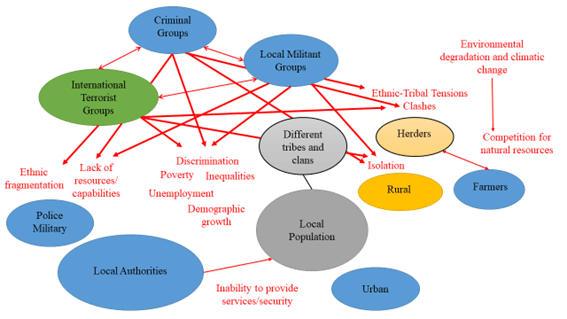
In this context, terrorist groups exploit communal grievances and pit different tribal and ethnic groups against each other. In this way, they undermine the authority and legitimacy of the authorities and increase the distrust of the population towards the state (Ammour, 2020). (See Figure 2: Influence Diagram of the Actors in the Sahel Countries).
This situation is further complicated by the inability of governments to reverse economic, political, and social inequities and solve institutional and structural failures (Ezemba, 2022). The greatest risk in terms of security would be the collapse of state structures in the Sahel countries. This, which has already occurred before in countries like Somalia, would cause chaos and a power vacuum that would give rise to micro-territories dominated by warlords, terrorist or insurgent groups and criminal organizations, in constant struggle against each other (Fagin Taboada, 2017).
In the Sahel, many layers of structural weakness and conflict come together. It is a space in which a set of local and international economic and political forces, social and ethnic relations, and trade and smuggling networks interact that have evolved over decades and, in many cases, centuries. In combating extremism and violence, the authorities must reconfigure the interests and dynamics between the various non-governmental actors (Cooke and Sanderson, 2016).
In a security context marked by violent extremism and armed conflict, women and girls experience the double impact of an unstable security context and social discrimination (Alliance Sahel, 2021). To interrupt worsening cycles of poverty and instability, the international community must collaborate with Sahelian communities and governments to increase investments in women and girls. They must recognize the centrality of gender to security, sustainable development, and political outcomes in the Sahel (Castillejo, 2015).
Many national and international efforts have largely focused on countering violent extremism by military and police means. The current responses to religious radicalization have been mostly kinetic and they have been less effective than had been hoped, due to a variety of aspects including their often-negative reception by the local populations as well as a lack of adequate synergy between the organizations involved. Combating radicalization in the Sahel is not just a question of fighting extremist groups but also reducing perceived marginalization as well as increasing economic opportunity in rural areas. Unless the drivers of violence are addressed, radicalization is expected to grow, often incorrectly attributed only to religion.
Figure 1: PMESII Analysis of the Sahel Countries.
| DOMAINS | THE SAHEL |
| POLITICAL | Cross border political instability Intercommunal disputes Political immaturity (weak political institutions and systems) Ethnic-clan loyalties and dynamics. High number of armed groups with conflicting-converging interests. Mistreatment, favouritism and discrimination towards some groups (grievances). Inequalities between rural urban areas. International terrorist groups exploit the situation. Influence of regional-international dynamics (Arab Spring: Libya). |
| MILITARY | Mostly kinetic approach to counter terrorism. Need for a regional approach. Lack of budget, limitation of projection power and inability for joint and combined operations. Lack of cohesion (ethnic tensions and polarization). |
| ECONOMIC | Economic dependence. Underdevelopment of transport and energy infrastructure. Lack of development and training of human resources. Low per capita income and high debt ratio. High dependence on agriculture and grazing. Corruption (Weak judicial system). Economic links between terrorism and organized crime. |
| SOCIAL | Demographic explosion. Migration to the cities. Ethnic and social disparities. Increasingly use of violence as protest or opposition. Degradation of the environment and climate change. Unemployment and lack of opportunities. Poor health and education services. Traditional smuggling routes. |
| INFRASTRUCTURES | Poor infrastructures (difficult access to the periphery). Lack of long-term development plans. |
| INFORMATION | Weakness of local information structures and services. Strong presence of the terrorist groups in the media and social networks. |
Figure 2: Influence Diagram of the Actors in the Sahel Countries

Bibliography
African Union. “One-Stop Center”, protection of women and girls against sexual and gender-based violence in the Sahel. Press release. September 12, 2022. https://au.int/en/pressreleases/20220912/protection-women-and-girls-against-sexual-and-gender-based-violence-sahel
Alliance Sahel. Gender Equality And Women’s Empowerment: A Unique Opportunity For The Sahel. 08 March 2021. https://www.alliance-sahel.org/en/news/gender-equality-sahel/
Ammour, Laurence Aida. State-backed armed governance in the Sahel stirs ethnic conflicts. Peace & Security, Sahel Watch. 25 February 2020.
Antunez, J.C. (2021, June 01). Understanding the Operational Environment: the Human Dimension. Global Strategy. Retrieved from https://global-strategy.org/understanding-the-operational-environment-the-human-dimension/
Bados, Victor. Guidelines for Commanders and Staffs: Operationalization of Culture into Military Operations: Best Practices. Spanish TRADOC, Granada, (2010).
Castillejo, Clare. Gender inequality and state fragility in the Sahel. FRIDE. Policy Brief. No. 204. June 2015.
Cincotta, R. and Smith, R. What future for the Sahel? Atlantic Council. 4 November 2021. https://www.atlanticcouncil.org/in-depth-research-reports/report/what-future-for-the-western-sahel/
Cooke, Jeniffer G. and Sanderson, Thomas M. The Context: Corruption, Fragility, and Hardship in the Sahel and Lake Chad Basin. In Militancy and the Arc of Instability. Center for Strategic and International Studies (CSIS) (2016).
Defis Humanitaries. The Sahel is a demographic bomb. 27 November 2019. https://defishumanitaires.com/en/2019/11/27/the-sahel-is-a-demographic-bomb/#:~:text=On%20a%20continental%20scale%2C%20the,with%20the%20exception%20of%20Niger
Demuynck, Méryl and Coleman, Julie. The Shifting Sands of the Sahel´s Terrorism Landscape. International Center for Countering Terrorism (ICCT). 12 Mar 2020.
Echeverria, Carlos. Mali y el resto del Sahel occidental como escenario privilegiado del activismo yihadista salafista. In Grupos militantes de ideología radical y carácter violento. Área del Sahel. Documento de Investigación. 22/2017.
Estelle, Emily. The Salafi-Jihadi Base in the Sahel: December 2018. Critical Threats. December 19, 2018.
Ezemba, Olumba E. and Stubbs, Thomas. Herder-farmer confict in the Sahel needs a new description: why “eco-violence” fits. The Conversation. July 12, 2022.
Fagin Taboada, José Carlos. El Sahel, amenazas de la nueva frontera. Instituto Español de Estudios Estratégicos. 13 de febrero de 2017.
Fuente Cobo, Ignacio. Yihadismo en el Sahel: la expansión de la amenaza oscura. Instituto Español de Estudios Estratégicos (IEEE). 21 de marzo de 2016.
Hashim, Ahmed S. War in Mali. Islamists, Tuaregs and French Intervention. Counter Terrorist Trends and Analyses. Vol.5. No. 2 (February 2013). Pp 2-8.
Hyndman, David and Flower, Scott.CHAPTER 1: Cultural Research in ABCA Armies Civil–Military Operations. The Crisis of Cultural Intelligence. World Scientific, pp. 1-22 (2019).
Instituto Español de Estudios Estratégicos (IEEE). Seguridad y desarrollo sostenible en el Sahel: un enfoque regional. Documento de Trabajo 01/2017.
Lyammuri, Rida. Tribal Dynamics in the Sahel. Policy Center for the New South. October 2019.
Moore, Gregory, Ahmad, Haaris, Simm, Lesley, Surdu, Razvyan, and Kovacs, Peter, Human Aspects in NATO Military Operations, NATO Humint Centre of Excellence, Oradea, Romania. October, 2014.
Mora Tebas, Juan Alberto. Sahel: un tsunami demográfico… ¿reversible? Instituto Español de Estudios Estratégicos (IEEE). 17 de enero de 2018.
OSCE, OSCE strategy to address threats to security and stability in the twenty-first century, 2003.
NATO South Hub. Drivers of religious radicalization and extremism in the Sahel. November 2020.
NATO Southern Hub. The Challenge of Youth Bulge in Africa and the Middle East. April 2021.
NATO Southern Hub. Migration in the greater Mediterranean region. Root causes and consequences for international governance and human security. July 2021.
NATO South Hub. Mapping the Terrorist Threat in the South. Case study: Rivalry and Confrontation among Terrorist Groups. August 2021.
OECD. Gender. Sahel and West Africa. https://www.oecd.org/swac/topics/gender/
Pradell, J-M. Rapid population growth of the Sahel Region: A Major Challenge for the Next Generation. Ideas4Development. 17 June 2021. https://ideas4development.org/en/population-growth-sahel-challenge-generation/
Raymond, Derek, Human Domain Mapping in 21st Century Warfare, Small Wars Journal, 22 August 2015.
SHAPE and HQ SACT, Knowledge Development Concept, 12 August 2008.
Sidatt, Haroune. Volatile Ethnic Conflict in the Sahel. Center for International Private Enterprise. 11. 24. 2020.
Stanicak, Branislav and Betant Rasmussen, Mathilde. Jihadist networks in sub-Saharan Africa. Origins, patterns and responses. European Parliamentary Research Service (EPRS). September 2021.
Sulemana, Mohammed. Islamism in West Africa: Context and Enabling Factors. Counter Terrorist Trends and Analyses. Vol.7. No 2 (March 2015). Pp 19-23.
Supreme Headquarters Allied Powers Europe (SHAPE), Allied Command Operations Comprehensive Operations Planning directive COPD Interim V2.0, 04 October 2013.
Terrazas, B. (2022, June 02). The Human Element: The Other Half of Warfare. The Strategy Bridge. Retrieved from https://thestrategybridge.org/the-bridge/2022/6/2/the-human-element-the-other-half-of-warfare
U.K. Joint Doctrine Culture and Human Terrain Joint Doctrine Note 4/13 (JDN 4/13). September 2013.
UK Stabilization Unit. Joint Analysis of Conflict and Stability. Guidance Note.June 2017.
U.S. Joint Chiefs of Staff, Joint Concept for Human Aspects of Military Operations (HAMO), 2015.
U.S., FM 3-24.2: Tactics in Counterinsurgency, 2009.
Walther, Oliver J. and Christopoulos, Dimitris. Islamic Terrorism and the Malian Rebellion. Terrorism and Political Violence, 27:497-519, 2015.
Editado por: Global Strategy. Lugar de edición: Granada (España). ISSN 2695-8937